

It’s so easy to be an armchair gamedev. Like you see all the devs on YouTube and watch projects progress on Reddit and you think “I could actually do this”. Sure, why can’t you make a game? Especially once you you’ve dabbled in a game engine, done a few tutorials, and gotten some mechanics working. You’ve even gotten Pong to work! Plus, you have this amazing idea for a video game which will blow peoples’ minds (if only you could actually make it).
Our story so far: we decided to become gamedevs while traveling around South America in our camper van. I learnt some Unity basics while my partner developed her skills pixel art. We ditched Unity for Godot, switched pixel art for 3D, both skilled up in 3D modeling, and tried to join some teams as modelers, which just made us realize how much we wanted to work on our own project. I stepped up my programming game so I could actually make some of the tons of ideas I have. So was it finally time to get a game out?
We aren’t just motivated by our love for video games – though that’s part of it. Video games have helped me learn about strategy, logic, math, physics (looking at you ONI), history (oh Colonization) and, as a non-native English speaker, things like phalanxes and chariots would have never gotten in my vocabulary as quickly if not for my countless hours in the other Sid Meier’s creation. I understand not everything is accurate, but it would definitely beat any superhero movie and I really miss the in-game encyclopedias full of information on, for example, the Wonders of the World.
But more than that, we really want to make games that will have an impact, to make people see the world through different eyes. That’s why we had switched to 3D – our first attempt at choosing a small, achievable project led us to the idea which involved a character in a developing country selling items on the street to help their family survive. The game idea was promising – fun mechanics, a cool story, and a powerful message. We even made a small prototype, and making it made us realize that, especially with the narrative twist we had in mind, this game would not work in 2D, so we’d need to switch to 3D.
However, after getting more experience in 3D, we eventually had to admit that it just wasn’t feasible for us to make a 3D game by ourselves at this stage of our journey. Coming off the back of working on others’ projects, we really wanted to make something that was ours – our idea, our message, our unique art style. Aside from that, what started as a simple little game had blown out into a much, much bigger project (where have I seen that before?). So it was time to switch gears, go back to 2D and make a simple game – really keep it simple this time – and set a goal to put it up on Steam. (Please don’t check our Steampage, unless you want to follow it for when it happens)
Joining a game jam seemed like a good way to get started on this new path – it would give us an opportunity to practice 2D again, help us stay motivated, and the added pressure of the deadline would encourage us to finish, forcing us to focus on a small project. We’d done a couple of 2 and 3 day jams in the past, but had crashed and burned in the last one which had been pretty soul-crushing and shaken our confidence. So when we came across the slightly longer Godot Wild Jam, it seemed perfect.
The Godot Wild Jam is a monthly 9-day jam which is run by a friendly and very active community. Each jam has not only a mandatory theme, but also several wild cards that you can choose to include – which I find helps come up with unique ideas. We joined the GWJ #68, which had the theme “forge” and committed to make a small 2D game with just the two of us. We’d learnt from our last defeat to choose something we knew we could pull off in the time frame, so we went for a straight-forward platformer knowing there were plenty of tutorials around this theme to help if we got stuck.
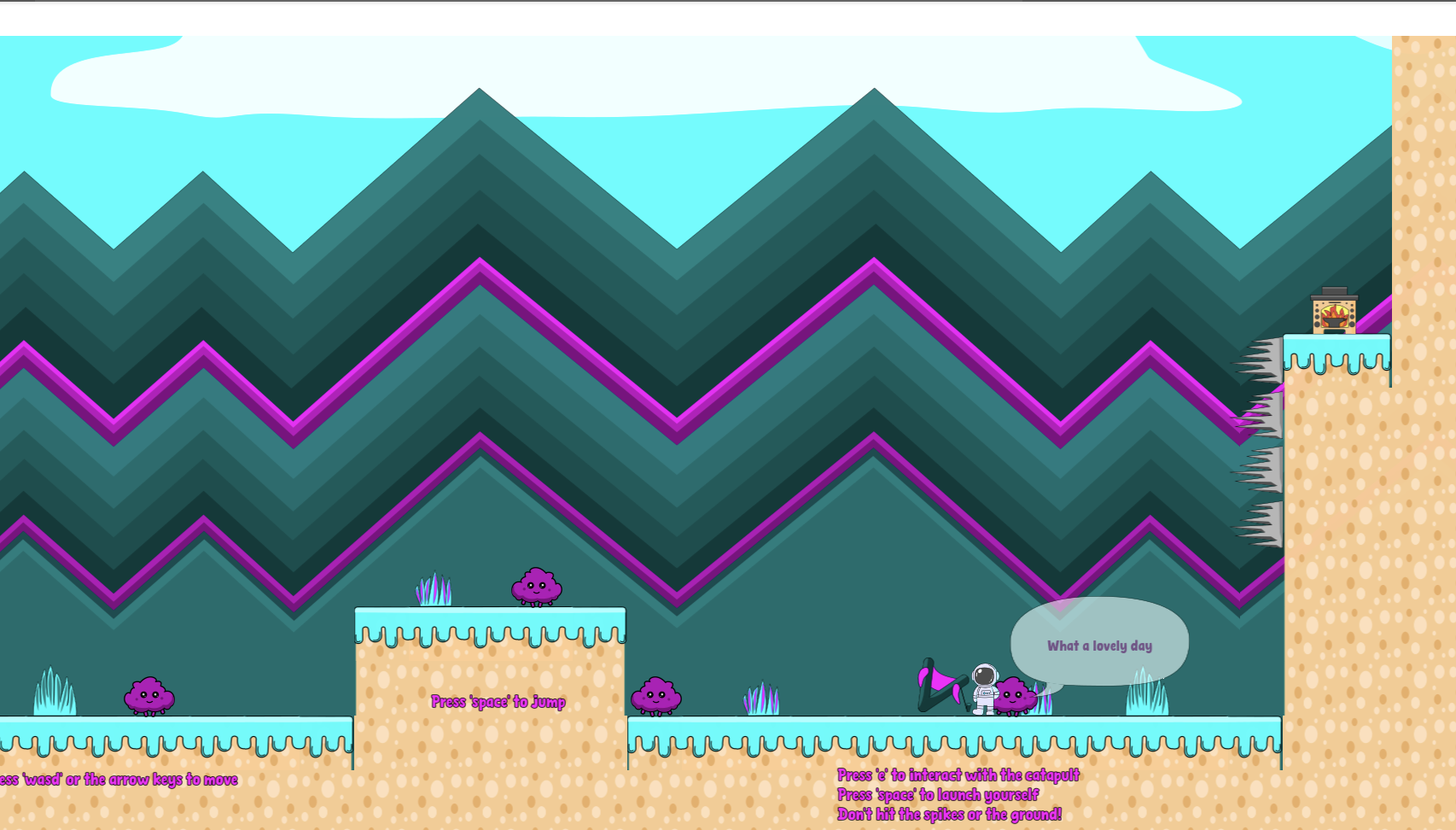
Of course, even super simple things are deceptively difficult in gamedev. It also didn’t help that we were still quite new to Godot, especially the programming side. A moving platform that the player can stand on may sound easy to make, but can turn into a 3-day problem solving exercise. But we got it done before the deadline, and submitted a complete, playable game – the game is not spectacular and might still be a bit buggy – you can play it on Itch if you’re interested.
Game jams can teach you a lot, from technical skills to working in a team, but I think the biggest lesson we learned through doing the jam was not to over-scope. It really highlights the value of a small, self-contained game (or even just one mechanic) you can actually finish, compared to the super cool idea that sounds amazing but you’ll never get done in practice. Game jams are also the perfect forum to focus on one aspect or skill you want to develop and go for it – pick your battles, focus on what you can do and pull it off. Maybe even execute it well.
Well, to be honest we had to go through a lot more to really come to that conclusion – there have still been more than a couple over-scoped projects between then and now. But this was a good start, and it felt really good to put a completed game out to the world, or at least the GWJ community. Most importantly, it encouraged us to join the next jam, then the one after that, and eventually take on bigger and more commercial projects.
This really comes back to the adage of “don’t bite off more than you can chew”. Tackling an overambitious project will inevitably lead to it ending up unfinished as you lose motivation or succumb to the temptation of chasing the next shiny idea, or worse still, get so burnt out that you give up on gamedev completely. With time and plenty of experience gained from doing multiple smaller projects, who knows, you might just be able to pull off your dream game in the end, or maybe meet some friends along the way.
Leave a Reply